

How To Repair Fiberglass Pool Slide
Puddle Slide Care & Repair
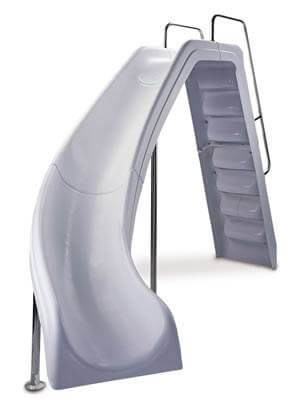
Puddle Slides are loads of fun, always ready for action. Since they are not mechanical, we don't oft think of maintenance or repair issues – just they do exist.
In the last ten years, pool slide construction materials accept inverse, and this has led to presumably less maintenance or repair issues.
For instance, slides are no longer made from a fiberglass beat, with a thin gelcoat surface. Rotomolded polyethylene, or thermoplastic acrylic surfaces are used nowadays, with the color all the way through. And ladders are unlike too – gone are the flimsy aluminum legs, most slides now accept a closed ladder design, which not simply looks improve, but is safer too.
Nevertheless, even these new style pool slides will need cleaning, maintenance and repairs. And, there are thousands of older puddle slides installed in America, in need of some tender loving care.
Then then – here'southward a short commodity on how to clean and maintain a puddle slide, and some data on making some common pool slide repairs on your ain.
Pool Slide Cleaning
Cleaning a puddle slide is needed every few months to go on the original luster of your pool slide. Ladder treads and the elevation of the slide deck can catch grit and dirt, held fast by air borne oils and pollutants. Pilus products, skin balm and tanning oil residues can be left behind by users, and your slide could become the occassional target for birds flying overhead. The slide legs, which can exist powder coated steel or aluminum, tin can develop scale or rust on the surfaces or around nuts, bolts and flanges.
Puddle slides become dirty – and need at least an annual cleaning.
For all surfaces, if you clean it oft, you will only need to utilize a small amount of dish soap and a soft cloth. For a deeper cleaning, you lot can gently use a granulated chlorine powder (not pool shock!), like Bon Ami or Clorox pulverization. Be careful not to scrub too hard, and apply only a soft cloth. Windex (Ammonia) can be used to bring a polish or quick wipe downs. You also can use Formula 409 or Fantastik cleaners.
 Don't utilize abrasive scrubbing pads, and don't apply vinegar, Lysol, Pinesol, or other general purpose cleaners or disinfectants to clean a pool slide. Whichever cleaner you use, don't use too much, to keep the balance from getting into the pool. Some cleaners contain phosphates and nitrates that are all-time kept out of your puddle.
Steel or Aluminum ladders and legs tin be cleaned with the same cleaner, and rinsed onto the pool deck. Often, a quick wipe with a soft clean cloth and some windex is all that'southward needed. Employ Bon Ami for scale build-up on aluminum.
For saltwater pools, indoor pools or pools by the ocean, it is recommended that the slide surfaces exist rinsed daily to remove salt buildup. Cleaning schedules should exist accelerated too, to keep the slide looking good.
 Rinse slide well, and so tape a heavy plastic trash bag onto the lesser of the slide, to take hold of soapy rinse water. Bonus tip – empty the bag before it gets too full!
Pool Slide Maintenance

Once per year, brand a pool slide inspection – for safety and maintenance.
- Check tightness on all bolts, and audit closely for any problems.
- Bank check the water supply organisation for leaks or worn components.
- Bank check that alarm labels are all the same readable, not torn or faded.
- Check ladder treads for any sign of clothing, yield or fatigue.
- Check the slide surfaces for any cracks or chips.
- Check the bolts and nuts for any scale or rust.
- Climb the ladder and inspect it top-side.
- Bank check water supply jet direction.
Pool Slide Repairs
- Surface Scratches – Very calorie-free scratches, scuff marks and haze tin can be hand polished with Permatex Plastic Cleaner or Gel-Drinking glass. Follow the manufacturer's guidelines. Clean cotton wool fabric works all-time for applying the polish and buffing. Turtle Wax white polishing compound can also exist used for deeper scuffs and scratches.
- Surface Cracks – Newer rotomolded and acrylic slides rarely crack, but if they practise, it can be fixed. It requires a plastic welder and PE plastic which can be purchased in apartment rods. Later on training, new cloth of a similar color is melted into the crack, sanded and polished. Fiberglass slide cracks are more mutual. It tin be pocket-size stress cracks in the Gelcoat surface, or in rare cases, the fiberglass trounce itself can become cracked. Gelcoat repair kits tin can be purchased, or your slide could be completely recoated, past a local gunkhole repair visitor. Fiberglass repair kits are likewise available, ordinarily sold for fiberglass gunkhole hull or car panel repairs.
- Ladder & Legs– For steel legs, (used on the larger pool slides) if rust develops around bolts or flanges, it should be sanded and touched up iwith Rustoleum. Matching paint tin can be purchased from the manufacturer. Steps or treads that show any sign of stress, or are bent or bowed should be replaced. Replace whatsoever stripped cleaved or loose bolts or deck lags. Information technology'southward recommended to employ only hardware from the original manufacturer.
-
 Water Supply Bug – Modernistic slides no longer employ the skinny 1/iv inch diameter hose and those tiny jets. New slides may have a 1 inch pipage, which rarely requires replacement. Jet nozzles may clog in areas of difficult water, and may need to be reamed clean. Connection gaskets volition need replacement at some betoken, as volition the valve that turns on the water to the slide. Older slides can purchase a complete slide hose / parts kit to replace the 1/iv inch hose, gaskets and slide jets.
Call back that pool slides take a weight limit of 200-275 lbs. Exceed this limit and the slide could become damaged, or the slider could become injured. For more on safety and intended employ of your pool slide, please see the owner's manual.

Source: https://blog.intheswim.com/pool-slide-maintenance-repair/
Posted by: bennettnoce1980.blogspot.com
0 Response to "How To Repair Fiberglass Pool Slide"
Post a Comment